
Let me tell you what this article is not.
It’s not me telling you which products you should use to get flawless skin.
It’s not a recommendations page for the best retinol serums.
It’s not about whether stick-on sunscreens are better than spray-on ones.
It’s a somewhat strange fable about the lessons I’ve learned during my journey with Dermatology.
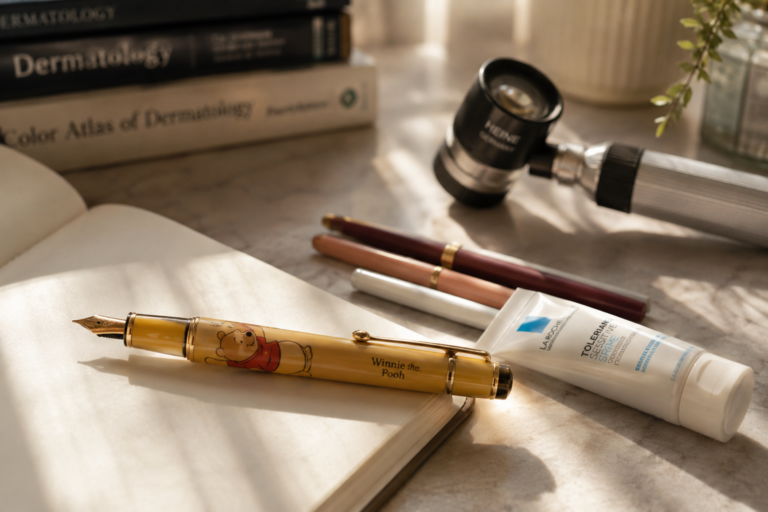
Dermatology – the science of skin – was never the specialty I thought I would end up in.
Growing up, I had imagined myself becoming more of a hardcore Surgeon or Physician when I became a doctor.
But life rarely turns out exactly the way you imagine it to, does it?
I’d watched hundreds of advertisements promising fairer skin and, conveniently, the success that would supposedly tag along with it.
Whenever that particular advertisement for a neem face wash for acne popped up, I paid attention, because that was what girls were expected to do.
Put in their best efforts to look pleasing.
I wanted to have nice skin too.
Skin that didn’t get darker around my eyes or around my mouth. Skin that wasn’t marked by an old chickenpox scar or by a mole that wasn’t quite where I would have put it.
I remember the first day I slathered sunscreen on my face as a fourteen-year-old and showed up in class.
My classmates gawked.
One particularly mean girl told me to my face that I looked like a whitewashed wall.
It must be true, I thought.
I must look like a whitewashed wall.
Perhaps it was because I had already convinced myself that I could afford to look like that because, well, nobody was looking at me anyway.
Or perhaps I simply didn’t care enough about what those classmates thought.
I don’t know what made me continue using sunscreen and a night cream religiously, every day for years.
But I did.
And then, over the next five years, something happened.
My tan had cleared.
The acne spots had faded.
And my skin looked radiant.
That was how I first came to believe that this stuff actually worked.
I was lucky. I happened to be using the right creams, with the right ingredients.
But in the years since becoming a dermatologist, I have met many women who weren’t nearly as lucky.
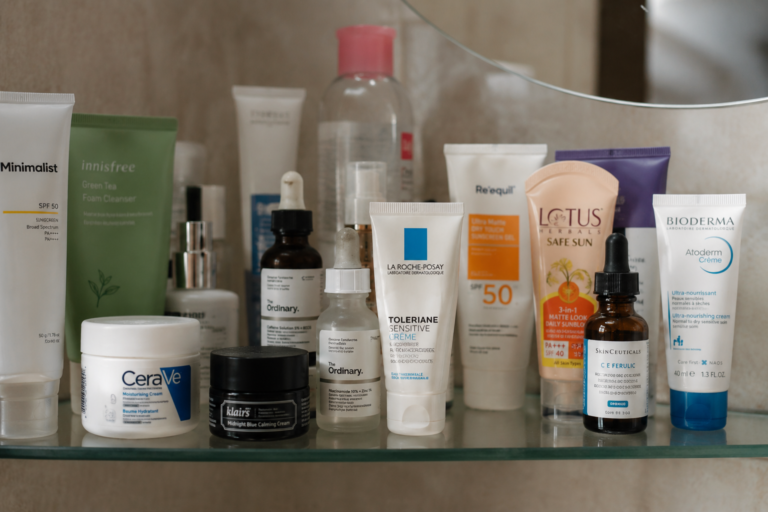
The girl who used the wrong tube of whitening cream – perhaps one containing potent topical steroids or heavy metals – may initially be enthralled by the remarkably fast results.
But what looks like a miracle can come at a price.
With prolonged use, these products can, sometimes cause difficult-to-reverse damage to the skin, and have consequences beyond the skin as well.
This is why there is one principle I would wholeheartedly endorse:
Be consistent with the right skincare.
And keep doing it.
Every day.
After day.
After day.
That is what actually matters.
In today’s world, with influencers and unqualified cosmetologists swarming social media with ten-step routines and fancy procedures, it can feel almost impossible to decode what to use and what not to use.
My take is simple.
If you are going to put something on your skin – the largest organ of your body – every single day for decades, you should be reasonably sure that it is the right thing for you.
Hasn’t consulting a skin specialist now become easier than ever ?
Even for people living in remote locations, teleconsultation can make it possible to obtain professional medical advice without having to leave home.
Rather than flitting from product to product, enchanted by the newest skincare trend – get advice from a trusted professional and then follow it (with a little thing that is surprisingly difficult to sell on Instagram:)
discipline.
But there is another lesson Dermatology has taught me.
Perhaps an even more important one.
The desire to have clear, bright, fresh-looking skin is something almost everyone I’ve met seems to harbour.
And it is reasonable.
It is understandable.
But it becomes problematic when that desire transforms into envy.
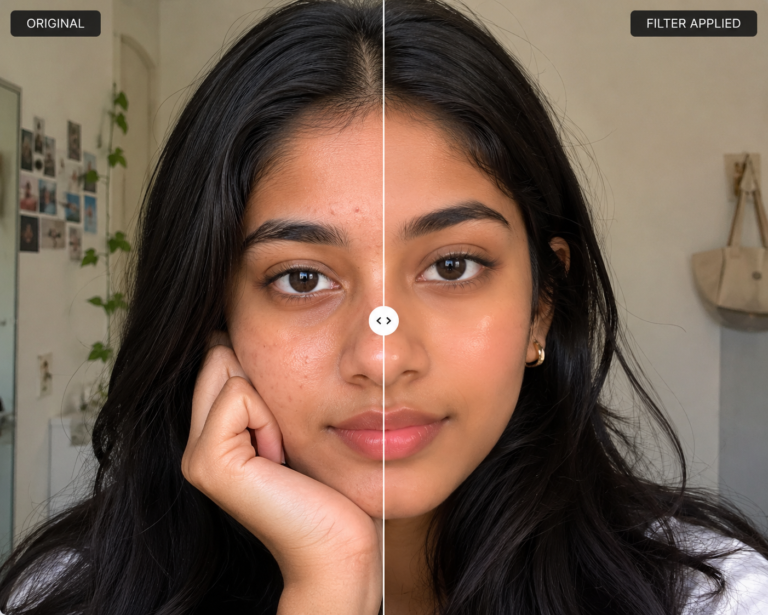
We post pictures on Instagram – but touched-up ones. Filtered ones. Carefully lit ones. Sometimes even altered ones.
And then we compare our real skin, in ordinary bathroom lighting, with somebody else’s carefully constructed image.
The result?
Hundreds of people seeking treatment for perfectly normal skin texture.
For the tiny crinkles around their eyes.
For pores.
For lines that appear when they smile.
For things that, not very long ago, we would simply have called- skin.
People tell me they want “Korean glass skin” and use exclusively Korean skincare products, without realizing something rather important:
To have Korean skin, you have to be Korean.
Our skin has its own biology. Our genetics, pigmentation, environment, age and countless other factors shape what our skin looks like.
There is no universal template for beautiful skin.
To lead a life of contentment—whether skin-wise or finance-wise—it is important to learn to be happy with the “good enoughs” rather than constantly chase a finish line that keeps moving further away.
Because there will always be another serum.
Another procedure.
Another person whose skin looks better than yours.
Maybe the real lesson is not how to achieve perfect skin.
And learning to be happy with good enough is a truly underrated skill, isn’t it?
