A good woman is supposed to be a certain way.
She must smile. Look pleasant. Be agreeable.
I remember being told to smile more when I was a teenager. Because that’s how good, agreeable women are supposed to be.
A good woman is supposed to be selfless. She should always put her children and husband first, and herself last.
She mustn’t raise her voice. Mustn’t talk back.
There are so many rules to follow that it becomes difficult to keep track.
The protagonist in Caro Claire Burke’s novel Yesteryear – Natalie Heller Mills, is, by all appearances, a good Christian woman.
She gets married at twenty to the love of her life and begins each day giving thanks. She lives in her five-million-dollar barn, baking sourdough bread from scratch and homeschooling her five, beautiful children.
But as the novel progresses, the facade begins to crack.
Natalie hates her husband. She thinks very little of him. She realises she has never felt emotionally connected to her children. She begins to see the glaring gap between her online “tradwife” persona — followed by five million people — and her actual self.
She has no real friends.
And she feels that being anything less than perfect is simply not an option.
At least, that seems to be the messaging she has been operating under.
So she gets up earlier than everyone else. Puts on the brightest shade of lipstick. Blows out her hair. Gets to work.

She captions her Instagram posts:
“A man may work from dawn to dusk, but a woman’s work is never done.”
And for someone who has tried to do everything right, who has poured so much effort into every single day (while her husband lazes around on online forums nurturing conspiracy theories), what does she get in return?
Her husband cheats on her.
She is defamed.
Her father-in-law allegedly tries to have her killed.
Because things are not always as rosy as they look from the outside.
The closest comparison I could make is with another famous novel – Han Kang’s The Vegetarian.
Both protagonists perform their assigned roles of womanhood extraordinarily well.
They are high-functioning.
Exemplary.
Until.
Until they break down.
Because perfection may be a beautiful ideal, but it IS NOT designed for real life.
A relationship isn’t supposed to be all smiles. Partners shouldn’t have to adhere to rigid gender roles dictated by the patriarchal ideas of marriage. They can argue, make up, learn, make mistakes and grow together.
A house doesn’t have to look as though it has been torn out from the pages of an interior-design magazine.
It can have scribbles on the wall.
Ketchup stains on the sofa.
Legos strewn across the hallway.
In recent years, “tradwife” influencers have become all the rage on Instagram, and I sometimes wonder: would this fantasy of staying at home, baking bread from scratch and devoting oneself entirely to the home have been a fantasy for women a hundred years ago?
I suspect not.
Because for those women, that wasn’t a fantasy.
It was the only life available to them.
They couldn’t have their own bank accounts. They couldn’t simply decide to get a job. They couldn’t travel independently. And leaving an unhappy marriage often meant stepping into financial and social uncertainty with nowhere to go.
It is so easy to blame modernity for the dissolution of the institution of marriage.
It is so easy to feel nostalgic for a time when marriages supposedly survived even the unkindest of acts.
But perhaps they survived because there wasn’t another road to travel by.
No place to return to.
No financial safety net.
No real choice.
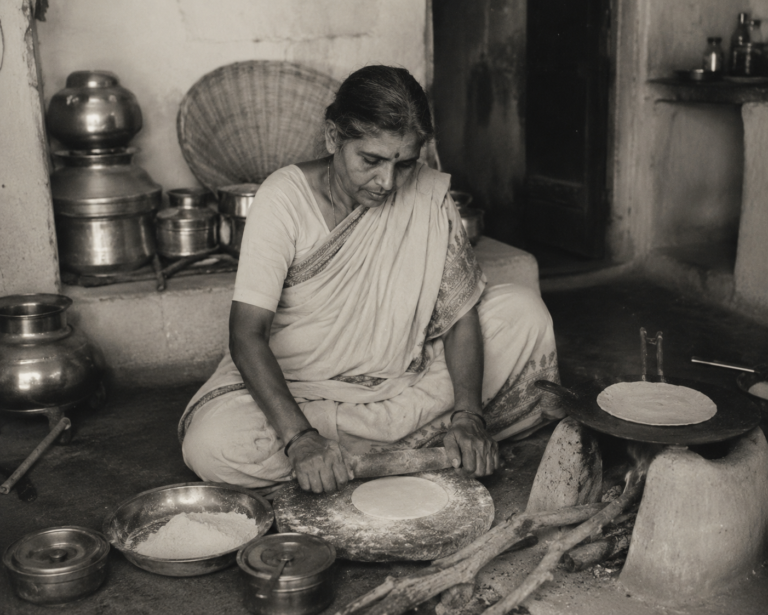
Our mothers, grandmothers and great-grandmothers have been playing this role of the self-effacing woman who prepares eighteen kinds of dishes for an Onam sadya and then drapes a settu saree and a wide smile after having fed and bathed the children.
I’ve seen it.
I’ve heard the messaging.
Don’t complain.
This is what it means to be a woman.
Or, as Min Jin Lee puts it, “A woman’s lot is to suffer.”
But is it?
Maybe being a good woman was never supposed to mean being a docile one.
Maybe selflessness was never supposed to mean self-erasure.
Maybe a good marriage is not one in which a woman quietly endures everything thrown at her.
I sometimes wonder. Can’t women just be?
Flaws and all.
Selfish sometimes.
Joyful.
Even loud.
And maybe the goal was never to be an idolized woman.
Maybe the goal is simply to be a real one.