

For as long as I can remember, I’ve been on the hunt for life’s meaning. So when I stumbled upon The Power of Meaning by Emily Esfahani Smith, it felt like I’d found a missing piece. The book describes four pillars of meaning — belonging, purpose, storytelling, and transcendence.
There was one idea in particular that stopped me in my tracks: in richer countries – where people are educated, independent, and individualistic – suicide rates are higher. In poorer, more religious nations, where people live within tight-knit families and shared obligations, the rates are lower. It felt like a tight slap in the face.
All my life, I’ve pursued education, independence, and freedom. They’ve brought me happiness, but did they make life more meaningful as well ?, I wondered.
I grew up in a small village where everyone knew everyone. We went to the same church, bought groceries from the same store, and visited the same local doctor. Sunday mornings meant church – attending Holy Qurbana, visiting the cemetery, chatting with our neighbours. The community was so interwoven that privacy barely existed. I longed to escape, to carve a life where I could finally make my own choices and not have to explain myself to anyone.
And I did.
Today, I’m a dermatologist in Vellore, mother to one, working six hours a day with time to meditate, work out, and read. I have the space I once dreamt of – no meddling relatives, no nosy neighbours to report to.
For a while, it felt perfect. But then came the quiet.
It was in that quiet that I realized what I was missing — community.

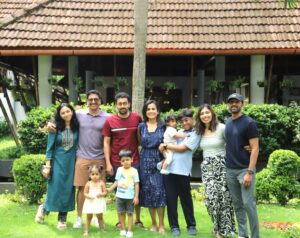
When Doanna and Jozy moved into the apartment above ours with little Diyara, something changed. We now had people to belong to. Someone to check in on, someone who checked in on us. Achu got a playmate, and laughter began to fill our evenings again. A sense of belonging started to take root , not inherited, but chosen.
Visiting the Hope House ( a charitable trust we are very fond of ) recently deepened that feeling. Meeting Divya and Monisha, the girls we sponsor, and watching Achu play with them made the world feel like a kinder place.
Hosting friends for a meal felt like extending that circle of meaning.
Maybe that’s what modern belonging looks like – small, chosen pockets of connection that give our days warmth.
As we move cities every few years, anchoring relationships becomes hard. But I’ve learned that meaning doesn’t just appear; it has to be built through effort and showing up. The village I grew up in had that built-in, but I had to learn how to rebuild it on my own terms.
For years, I looked down upon people who never left their hometowns — those whose worlds revolved around the pally perunnaal or the Sunday gathering. But now, I see something profound in their rootedness. They belong to their faith, to their people, to something beyond themselves.

I once used to think happiness was the ultimate goal – to feel good, stay comfortable, and be free.
But happiness, I’ve learned, is fleeting. Eating a Baskin Robbins ice cream might make me happy for a moment, but it doesn’t fill me.
Doing harder things – like raising a child, building a career, or showing up for others gives life meaning, even when it’s not easy.
What I seek now is balance – between independence and belonging, solitude and connection. I want to belong to others, but also to myself. To build a tribe that I’ve chosen, not one I’ve merely inherited. To keep some old traditions while creating new ones that fit this chapter of my life.
It won’t be easy, but I think it will be worth it.
Because at the end of the day, people need people. And meaning, I’m beginning to see, is not something we find – it’s something we build, together.

So true 💖
Straight from the heart!!